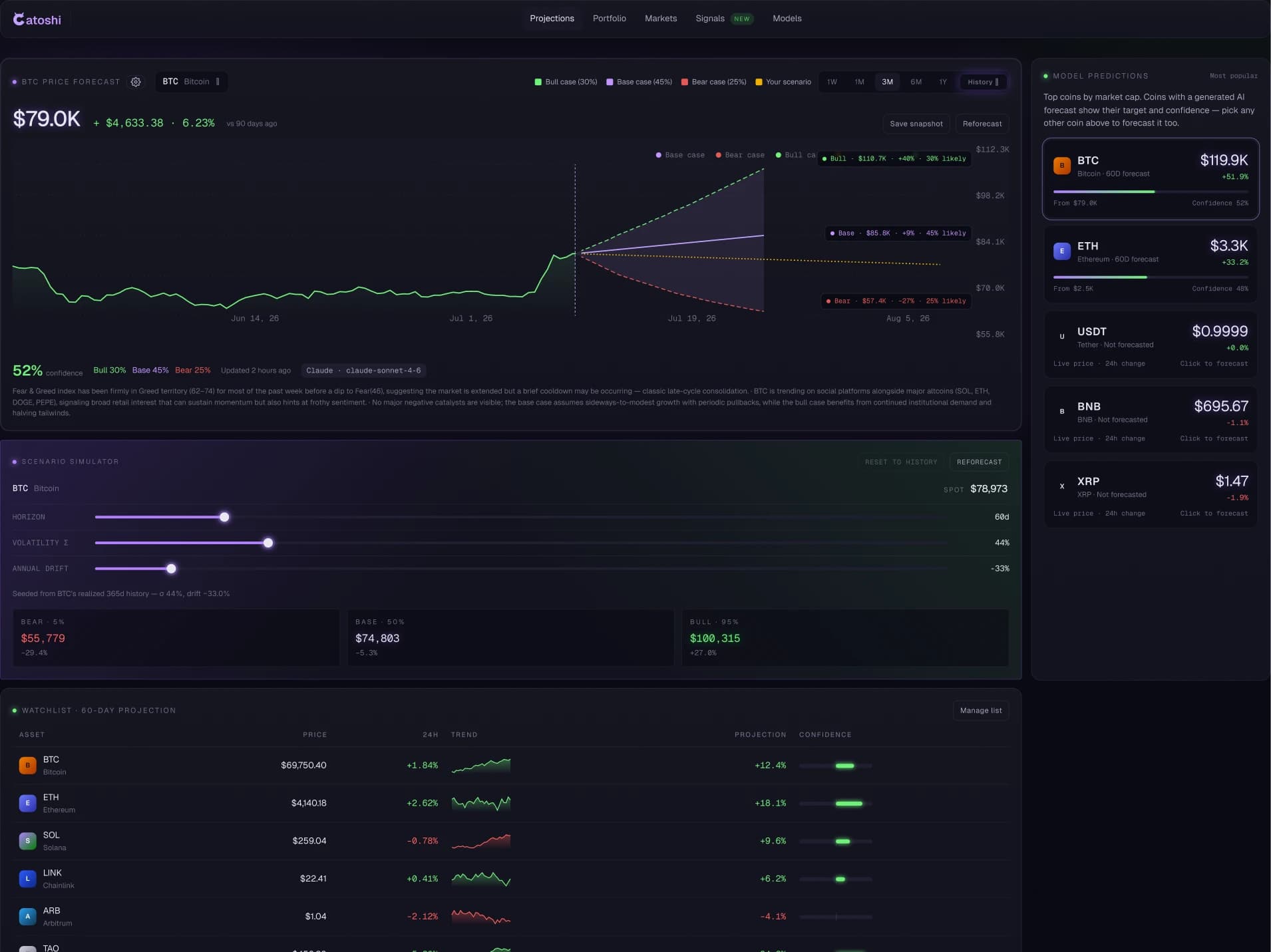
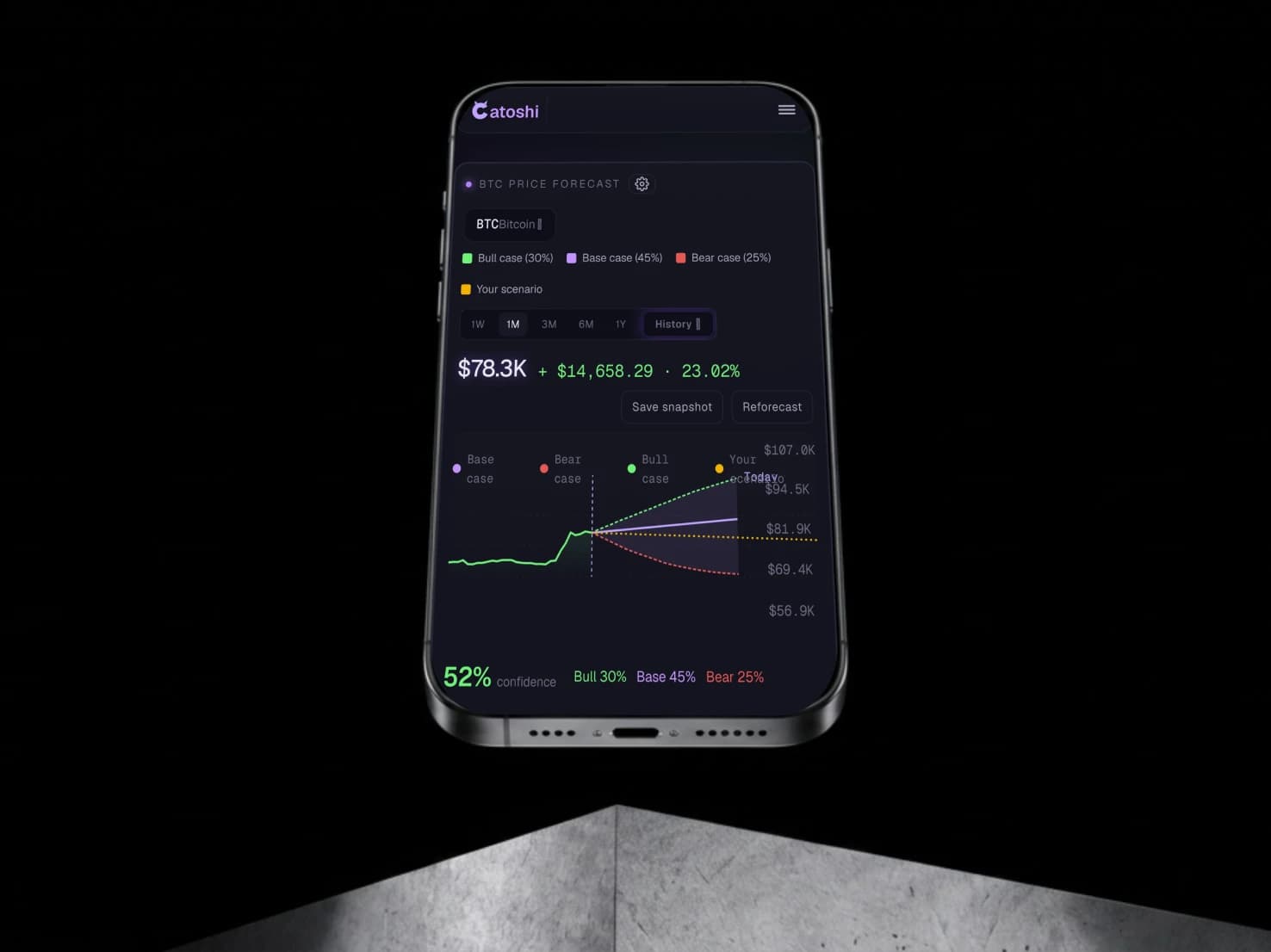
AI-Driven Crypto Market Analytics Dashboard
Crypto analytics dashboard that turns free market data into structured, probability-weighted AI forecasts — with a built-in loop that scores and calibrates its own accuracy over time.
Overview
Problem
Manual crypto forecasting is slow, inconsistent, and prone to the same mistakes repeating — chart-only calls that ignore positioning, funding, ETF flows, and macro triggers, and binary predictions instead of calibrated probabilities.
Approach
Built a Next.js dashboard backed by a data pipeline that pulls OHLCV, funding rate, open interest, long/short ratios, liquidations, ETF flows, and news sentiment from free sources (Binance, CoinGecko, Farside, RSS), compresses them into a compact market snapshot, and hands that snapshot to Claude with a forced JSON schema so every forecast comes back as labeled scenarios with probabilities — never a directional guess. Designed a Postgres/Neon schema with pgvector to store every snapshot and forecast, search for historical analog market states, and automatically score forecast accuracy via Brier score.
Stack
Outcomes
Build
Gallery